Imagine having a second brain for your operations
With Odomata, the brain is built-in ... automatically capturing what's said in meetings,
creating projects and tasks, assigning owners, and even filling out timesheets for you.
Odomata 2nd Brain
What “Odomata 2nd Brain” really is
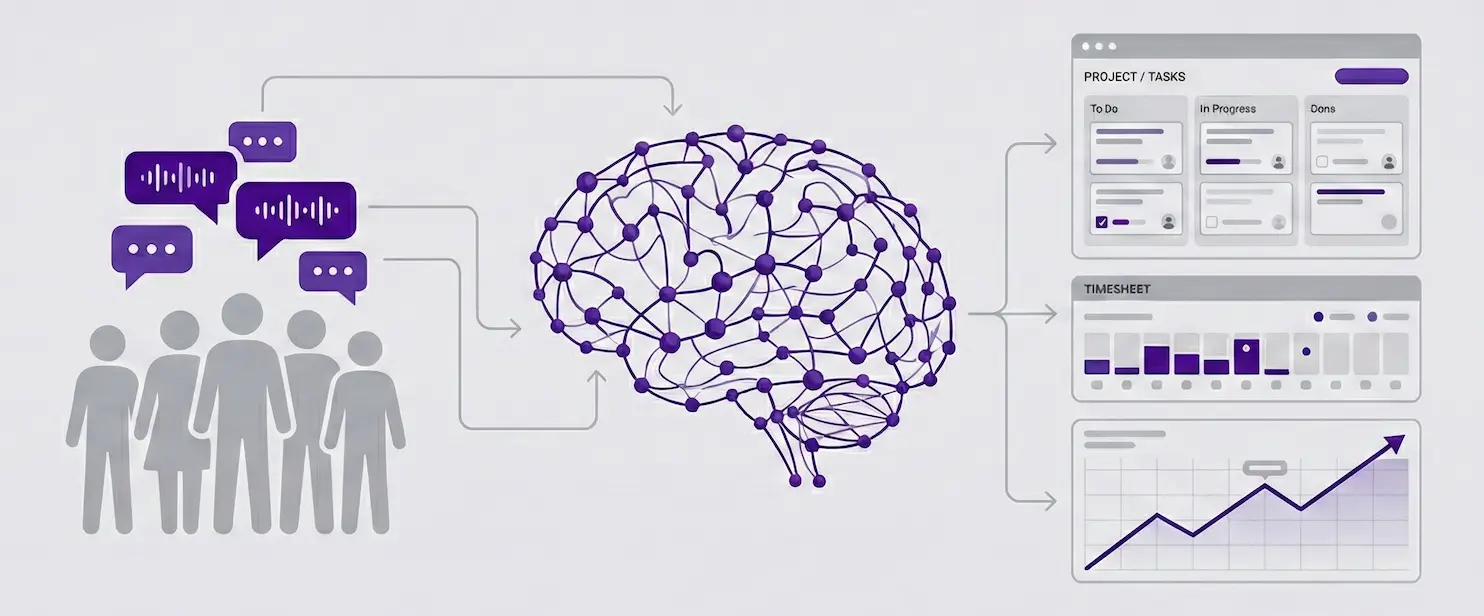
In plain language, Odomata 2nd Brain listens to your work conversations and quietly turns them into projects, tasks, assignments, and timesheets - inside the Odomata platform - without anyone touching a keyboard.
What it actually does
-
Listens to the work that’s already happening.
Joins your meetings or recordings in the background - stand-ups, project reviews, client calls, field debriefs, or even solo voice notes. -
Understands who said what and who needs to do what.
Identifies speakers and the people being talked about. It can auto-assign tasks to the right users and add them to the right existing projects. When there is no clear match, it drops them into a pre-configured container project for manual reassignment. -
Captures the operational footprint automatically.
From a single conversation, Odomata 2nd Brain can capture:- Tasks and assignments under the right existing projects;
- Tasks in a pre-configured container project when nothing matches yet, ready for triage;
- Due dates and priorities where possible; and
- Timesheets with the right user, description, and duration.
Why it matters
- Turns every conversation into revenue and momentum.
- Ensures billable time actually gets captured.
- Speeds up invoicing cycles.
- Removes the mental tax of “I still have to update the system later.”
This is exactly what people mean when they say, “I wish I had a second brain.” Odomata makes that literal inside an operational system.
In one sentence
Odomata 2nd Brain is the bridge between what’s said in the business and what lives in the system.
- Input: real conversations, meetings, and voice notes.
- Processing: understands context, people, and commitments.
- Output: tasks, assignments, and timesheets attached to the right projects (or your 2nd Brain container) in Odomata.
No extra logins. No extra forms. Just the work you’re already doing, captured and structured automatically.
Explore Odomata 2nd BrainReal-world scenarios
Real-world scenarios to make it tangible
Here are a few “day in the life” examples that show how Odomata 2nd Brain behaves in real operations.
Scenario 1 · Project kickoff call
The project is structured before anyone opens their laptop.
You’re on a 60-minute project kickoff with a client and internal team - discussing milestones, responsibilities, deadlines, risks, and follow-ups.
With Odomata 2nd Brain:
- The entire conversation is captured in the background.
- As people commit (“I’ll handle the schedule,” “Can you take that?”), 2nd Brain creates tasks and sub-tasks, assigns them to the right people, and links them to the correct existing project - or your 2nd Brain container if there’s no clear match yet.
- Timesheet entries are logged for participants with the right project, description (for example “Project kickoff - scope and planning”), and duration.
Result: when the call ends, the project work is already structured in Odomata, everyone sees their assignments, and the billable time for that meeting is captured - without anyone staying late to update the system.
Scenario 2 · Field supervisor debrief
The drive back from site updates the whole office.
A field supervisor is driving back from site and records a 5-10 minute debrief: “Job 214... Job 217... we need parts, a return visit, and a change order,” etc.
With Odomata 2nd Brain:
- The spoken debrief is attached to the right jobs or projects wherever there’s a match.
- Follow-up tasks are created - “order replacement parts,” “book return visit,” “prepare change order” - and assigned to procurement, scheduling, or the account owner.
- A timesheet is generated that reflects the work described, with the right codes, projects, descriptions, and duration.
Result: the supervisor doesn’t have to sit at a laptop and remember everything, office staff aren’t chasing updates, and billable work plus follow-ups are accurately captured and ready to move.
Scenario 3 · Solo thinking / planning
Late-night ideas show up as real work, not forgotten notes.
A founder, manager, or project lead records a 15-minute voice note about strategy, priorities, changes they want on certain accounts, and “someone should do X, Y, Z.”
With Odomata 2nd Brain:
- The note becomes a set of structured tasks, grouped under the right initiatives, projects, or accounts.
- Tasks are assigned to the right owners with due dates where it makes sense.
- Optionally, that 15 minutes is added as internal time under a “Planning / Management” category.
Result: ideas don’t die in notebooks, email drafts, or audio apps. They appear as real, trackable work items in Odomata, with owners and forward momentum.
Benefits
The second brain advantage
Odomata 2nd Brain isn’t just a clever idea - it translates into fewer dropped balls, better billing, and teams who spend more time on real work instead of admin.
No more lost decisions or follow-ups
- Important conversations are translated into structured work - projects, tasks, owners, due dates, and notes.
- You always know what was agreed, who owns it, and when it’s due.
- Less “What did we decide in that meeting?” and “Who was supposed to do that?”
Billable time is captured automatically
- Meetings, reviews, and debriefs become timesheet entries tied to the right projects.
- Less leakage of billable hours and fewer “best guess” time entries.
- Invoices go out faster and with more confidence in the numbers.
Teams focus on value, not admin
- People don’t have to remember to “update the system” after the real work is done.
- They can stay in their natural mode - talking, collaborating, solving problems.
- The system quietly keeps up in the background so effort flows into outcomes, not paperwork.
Talk like humans. Capture like a system. Bill like a business.
OUR ETHOS
Systems that run themselves
We believe the way to think about operations is simple: the system should carry the weight, not the people. When conversations, decisions, and work in the office or field automatically turn into structured projects, tasks, and timesheets, your organization moves faster with less friction. That’s what we mean by systems that run themselves.
Odomata is designed around how people actually work - talking, coordinating, solving problems - not around abstract process diagrams.
Meetings, debriefs, and ideas aren’t noise. Odomata treats them as primary input and quietly turns them into structured work.
The goal isn’t to squeeze more out of people - it’s to free them from low-value, mundane, admin work so they can focus on strategy, relationships, and outcomes.
Odomata (OH-doh-MAY-ta)
- odo
- Greek for "the way"
- mata
- Sanskrit for "to think"
Odomata = "the way to think."
For us, the way to think about operations is simple: build systems that run themselves.
Automate with Odomata